
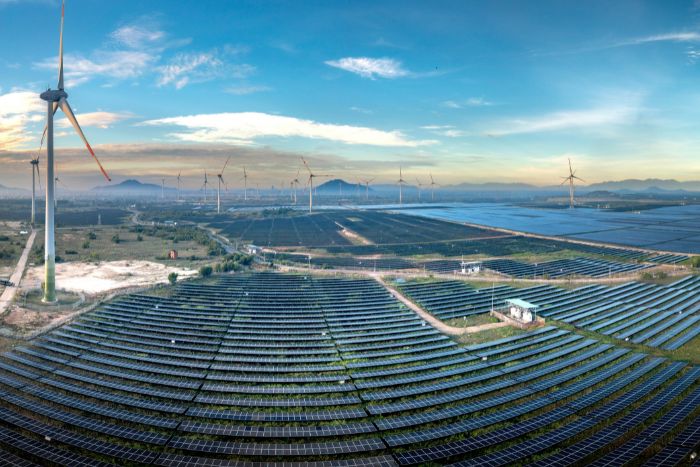
BlackRock, the world’s largest asset manager, has committed to investing ₹3,000 crore ($335 million) in Aditya Birla Renewables Ltd (ABREN), through the company Global Infrastructure Partners (GIP). According to The Hindu, there will be an initial investment of ₹2,000 crore, with a greenshoe option of investing another ₹ 1,000 crore in the future, in exchange for a minority stake.
With the influx of this ₹3,000 crore, the enterprise value of ABREN will turn into a sizable ₹14,600. Till now, ABREN has installed renewable energy capacity across 10 states in India, amounting to 4.3 GW. This includes solar, hybrid, floating solar, and round-the-clock renewable power.
India considers import duty cut for high-grade steel needed in wind sector
In a boost for the wind energy sector, the Indian government is mulling over reducing the 15% import duty on the high-grade steel needed to manufacture gearboxes for wind turbines, reported Mint. The ministry of new and renewable energy has recommended the tax cut to be taken up during the upcoming Union Budget.
The current import duty on gearboxes is 7.5%, which makes it cheaper to import than manufacture domestically. So, this move will localise the manufacturing of components that go into making wind turbines. This is in line with correcting inverted duty structures to boost local manufacturing, and a mandate to cut reliance on foreign component suppliers.
Power Ministry revokes connections of 24 RE developers due to delays
The Ministry of Power has revoked the connectivity for 24 renewable project developers since 2022 due to developer-side delays. According to Solar Quarter, the Ministry said that developers could not meet project milestones, including land documentation, financial closure, and commissioning deadlines. This was clarified in a written response by the Union Minister of State for Power, Shri Shripad Yesso Naik, to the Rajya Sabha.
Incidentally, 16 of these developers have gone to the Central Electricity Regulatory Commission (CERC) seeking protection against the revocation orders. As a result, there could be legal and operational issues in the foreseeable future.
The Ministry’s move is in line with the country’s compliance efforts to achieve 500 GW non-fossil fuel generation capacity by 2030. Currently, 259 GW of non-fossil energy capacity has already been integrated into the national grid.
RE can cost as less as new coal by 2030: Study
It is possible for India to have reliable, round-the-clock, clean power at costs competitive with new thermal plants by 2030, according to the findings of a report published by the International Institute for Sustainable Development (IISD) and the Center for Study of Science, Technology and Policy.
Titled ‘Budgeting for Net Zero: Powering India’s Reliable Clean Energy Future’, the study found that this hinges on two factors: the ability to monetise a portion of surplus electricity generated by oversized renewable sources as well as additional storage capacity. Firm and Dispatchable Renewable Energy (FDRE) — which is already cheaper than new coal considering its associated social costs —includes hybrid projects combining solar, wind, and battery storage.
The study found that FDRE projects install slightly more renewable and storage capacity than required for their contracted supply. Selling this surplus power plays a critical role in lowering overall costs.
No advisory to cease funding for RE projects: Govt
The Ministry of New and Renewable Energy clarified that it had not issued any advisory to pause or halt new financing for the sector, after it emerged that the Ministry had reportedly urged lenders to proceed slowly in financing new solar module plants, as supply had exceeded demand.
The Hindu reported that a lot of solar manufacturers got concerned as they felt that this move could choke financing for the entire sector. The Finance Ministry had been asked to advise lenders to adopt a “calibrated and well-informed approach” when evaluating proposals for additional standalone solar photovoltaic module capacity, citing oversupply risks.
About The Author

You may also like
Renewables are Cutting Down Power Prices Globally: Report
India’s PLI Drives Growth in Solar Manufacturing Sector: Report
In 2025, costs of storing renewables with batteries have fallen to its lowest ever: Report
Renewables providing one-fifth of electricity in 20 countries: Report
Clean Energy Push Would Halve Warming Rate by 2040: Report